It is often said that cities succeed when people want to live and work there, and we largely want to live where our heritage and history are preserved.
Rochester is proud of its unique architectural and landscape heritage, and its citizens recognize the importance of retaining and maintaining this built history. One tool to help accomplish this is the Preservation Ordinance, enacted by City Council in 1969. The ordinance allows for the designation of landmark properties and districts and defines the process to manage physical changes to these properties.
Preservation Districts
Rochester has eight Preservation Districts that contain approximately 1750 properties (view the listing here), just a small share of the buildings and landscapes eligible for historic designation. The districts emerged from surveys conducted in the 1960s, 70s and 80s that were collected in the 1986 Historic Resources Survey, which was amended by the 2000 Historic Resources Survey. Disparities between the two were addressed in the 2001 Report on the 1986 Historic Resources Survey Report. Periodic survey work will identify more properties worthy of landmark designation.
The eight Preservation Districts are listed below (click on the district names to view a map of each area):
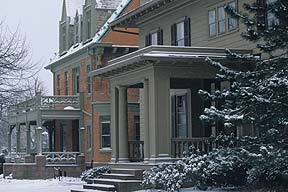
| East Avenue: Established 1969. East, University and Park Avenues and the streets between, from Alexander to Probert Street. Cited as one of the greatest catalogues of 19th and early 20th century urban residential architecture in New York State, the mile and a half long district is lined with an extraordinarily consistent array of elegant buildings. Regarded by many as the city's most beautiful street, East Avenue still retains much of its original character as the "grand boulevard" of Rochester. The side streets surrounding the avenue reflect the grandeur of the area on a smaller scale, but with equally impressive detail. |
|
|
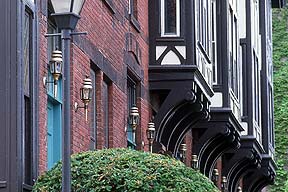
| Grove Place: Established 1971. A downtown neighborhood around the Eastman School dormitory. Significant both architecturally and historically, this compact district contains a variety of small-scale residential buildings. The neighborhood is the last remaining 19th century residential area within the central business district. It is historically important as the remains of the semi-private compound built in the 1800's by two prominent families, the Wards and the Seldens. |
|
|
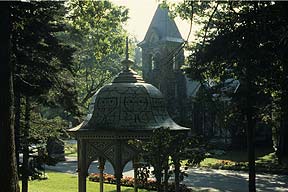
| Mt Hope / Highland Park: Established 1972. Exhibiting the horticultural heritage of Rochester, this district south of downtown includes the Frederick Law Olmsted designed Highland Park, and the nation's first municipally owned Victorian cemetery. Once the exclusive domain of the Ellwanger & Barry horticultural business throughout the mid to late 19th century, the district retains its elegant and spacious parkland character. The district is punctuated with notable architect-designed buildings combined with a more tightly-knit early 20th century subdivision along the district's fringes. |
 |
|
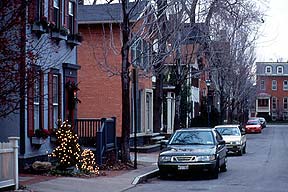
| Corn Hill / Third Ward: Established 1977. The "stuffed shirt" neighborhood just outside downtown where merchants in the early days of the Erie Canal built their homes. The oldest residential area in the city, the Third Ward was for over half a century Rochester's choice residential district. Millers, merchants, craftsmen and professionals built homes soon after the Erie Canal was completed nearby. The district includes examples of most of the residential styles popular during the early and mid 19th century, ranging from worker's cottages and carriage houses to elegant Greek Revival and Italianate mansions. |
 |
|
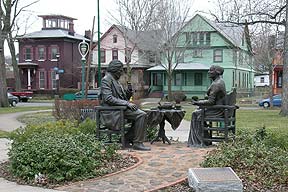
| Susan B. Anthony: Established 1980. Also just outside downtown, this neighborhood would still be recognized by its namesake, who lived at 17 Madison Street from 1866 until hear death in 1906. An outstanding example of a 19th century middle class neighborhood, the district is a compact area of four streets that surround a park square. The buildings represent a variety of architectural styles, including Greek Revival, Italianate, Second Empire and Queen Anne. Alongside the residential neighborhood are industrial buildings of the early 20th century, including the factories of the Cunningham Carriage Works, a maker of automobiles and aircraft. |
 |
|
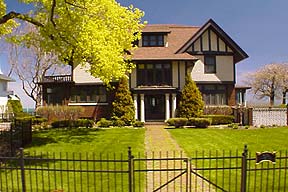
| Beach Avenue: Established 1987. Sitting atop a bluff overlooking Lake Ontario, this row of homes and elegant gardens can be experienced via a beachside walkway. Don't be afraid to take in the view: the walkway is a city-owned right-of-way that once bordered a street. |
 |
|
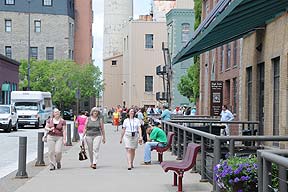
| Brown’s Race: Established 1990. Known as High Falls, this is where Rochester began. Raceways dug in the early 19th century fed water from the Genesee River into buildings to power flour and lumber mills. Several of these buildings remain, along with the city's waterworks and remnants of an 1816 mill. View the river side of the district and the waterfalls by crossing the 800 foot long Pont de Rennes pedestrian bridge. |
 |
Individual Landmarks
In addition to the districts, there are approximately 81 properties (view the listing here) that were designated as individually important. While some are within the preservation districts, others stand alone. These include the Broad Street Aqueduct over the river, the Powers Building and City Hall downtown, and the carousel at Ontario Beach. Interiors are also designated on a few selected buildings, including: the former Hallman's Chevrolet Showroom (now Spot Coffee) and the Masonic Temple (the Auditorium Center). Two of the properties - the George Eastman House and the Susan B. Anthony House - have the further recognition of National Historic Landmark, signifying the highest level of importance to the nation.
Appropriate Alterations
Whether in the districts or as individual landmarks, changes to any part of the exterior of these properties (and to the interiors of those local landmarks so designated) require review by the Preservation Board, as set forth in the City Code Section 120-194. Approval is required for all non-maintenance exterior work, including demolition, any alteration, any removal of features, and major landscaping. Painting is regulated only as to painting of previously unpainted surfaces and to any change of color in local landmarks. The Preservation Board must issue a Certificate of Appropriateness approving a change before a permit can be issued for any Preservation District property or landmark. The name of the certificate is telling: the new work must be appropriate to the property and to nearby properties. That is, it must "fit" aesthetically with its surroundings. Because it is sometimes difficult to define "fit," most applications are reviewed by the Rochester Preservation Board.
Design Guidelines
To better define what is appropriate in historic settings, the Rochester Preservation Board prepared design guidelines for various components of buildings and landscapes.
Replacement Window Policy
Windows and doors are character-defining components of buildings and especially of historic buildings. The Rochester Preservation Board believes that windows and doors, the elements within and around them, and their configuration on a building significantly enhance the character and value of buildings and preservation districts. Retaining this character and value is a primary duty of the Board, as assigned by the City’s preservation ordinance beginning in 1969. The Board believes that historic windows and doors, along with unique features such as stained or leaded glass, muntin patterns, fanlights, sidelights and trim, should be preserved through repair and restoration rather than be replaced. To help guide owners of historic properties, the Preservation Board adopted a Replacement Window Policy on October 5, 2011.
Technical Advice
The National Park Service has developed a series of technical papers on the maintenance and repair of historic buildings and landscapes. These highly recommended Preservation Briefs address anything from the best ways to clean brick to techniques for repairing plaster walls. The briefs are accessible online at: https://www.nps.gov/orgs/1739/preservation-briefs.htm.
The following guide was printed with help from the Landmark Society:
Nominate a Property for Landmark Designation
Section 120-193 of the City Code sets out the process for landmark designations. Any resident of the city may nominate a property. Both the Preservation Board and the Planning Commission review the nomination, and each applies specific standards to determine whether a property is worthy of designation. For district designations, City Council makes the final determination.
Incentives to Preserve
Both the state and the federal government provide tax credits for rehabilitating historic buildings. For information and application forms, contact the State Historic Preservation Office (https://www.parks.ny.gov/shpo/).
The City of Rochester provides a Historic Property Tax Exemption for improvements to properties in the eight preservation districts or to city-designated individual landmarks. The improvements must be for the purpose of preserving the property, so additions and a fancy new kitchen are not eligible. Changes must be appropriate to the historic context, and all work must be approved by the city's Preservation Board before construction begins. The exemption is not limited to exterior alterations, nor does it limit the use of the qualifying property. For more information, see the Assessor's webpage.