Search
City of Rochester

Mt. Hope Cemetery

Loading...

mtHopeStatue1133 Mt. Hope Avenue
Rochester, NY 14620
(585) 428-7999

Map to the Mt. Hope Cemetery
Map and legend of the grounds of Mt. Hope Cemetery

Information about burial and memorial options at Mt. Hope Cemetery

History

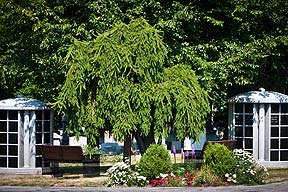
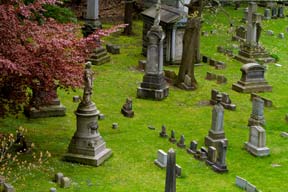
Mt. Hope Cemetery is a remarkable resource for the student of local history, funerary art, spectacular ancient trees or the geological grandeur of the Genesee Valley. It is one of the most remarkable Victorian cemeteries in America. The original sections, which are reached most conveniently from an entrance at 791 Mt. Hope Avenue, contain a wide variety of monuments and mausoleums, the graves of a cross section of the citizens of nineteenth-century Rochester, and an extraordinary landscape. In 1837, the City of Rochester purchased a tract of almost fifty-four acres and dedicated it for cemetery purposes on October 3, 1838. It was the first of the great Victorian cemeteries to be developed by a municipality. In 1839 the City built a decorative entrance and in 1874 replaced an early gatehouse with the present cemetery office and belltower, a neo-Romanesque design of the Rochester architect A.J. Warner. The elaborate design of the entrance area was expanded by the construction of the Gothic chapel in 1863, by the ornamental fountain surrounded by a circular drive, by the white Moorish revival gazebo to the right of the entrance drive, and in 1912 by the addition of a crematorium to the chapel. The crematorium was the work of J. Foster Warner, the son of the architect of the office. Gradually, the City expanded the Cemetery lands to include almost two hundred acres, making the tract large enough to keep it in active use for burials even to this day.

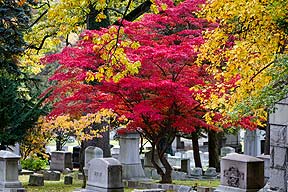
Old gatehouse at Mount Hope Cemetery.In the Nineteenth Century the citizens of Rochester were drawn - for many more uses than funerals - to the beauty of the cemetery landscape, to the spectacular views of the Genesee River, and to the delightful planning of the cemetery lanes (designed to conform to the unusual geological features of the land). This thoughtfully and imaginatively planned landscape was widely regarded as a special kind of park. Families came regularly for picnics and outings, walks and carriage rides. In addition to elaborate Memorial Day celebrations, the cemetery was a place used by the dead and the living. The full use of an urban cemetery represented a striking evolution from the original center for public burial: the churchyards. In the late Eighteenth Century, the churchyards of England and of some American cities had become so crowded that they were a hazard to public health. The urban cemetery or necropolis relieved this danger and became, in addition, a much appreciated amenity to planned city living.

Great American Citizens Laid to Rest at Mt. Hope

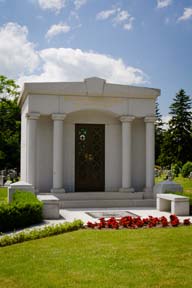
A walk through Mt. Hope provides a ready index to the citizens who built Rochester. Colonel Nathaniel Rochester, the official founder of the City, and his family, are buried on the top of a high hill in section R alongside Jonathan Child, Rochester's first mayor. The founders of Western Union, Don Alonzo Watson and Hiram Sibley, lie not far apart in section D. Frederick Douglass, the great newspaper editor and diplomat, is in section T; Susan B. Anthony, the most notable voice for the rights of women, is buried beside her sister Mary in section C. And not far from the Anthony family plot is the Woodbury mausoleum in which the founder of the Margaret Woodbury Strong Museum is buried. The Bausch family and Lomb family have plots in section D; Lewis Henry Morgan, the internationally known anthropologist, has an elaborate mausoleum built into the side of a steep hill in section F. The novelist and poet, Elizabeth Hollister Frost, is buried in section G and the imagist poet, Adelaide Crapsey, is buried beside her father Algernon, the embattled clergyman, in section 2 along Elmwood Avenue. The names on at least half the stones in the older sections are immediate reminders of streets, houses and businesses of present-day Rochester: even casual visitors can see monuments to Atkinson, Barry, Brewster, Burke, Campbell, Cobb, Crittenden, Harris, Hollister, Johnston, Kaelber, Likly, Lindsay, Lyon, Otis, Peck, Perkins, Pfaudler, Pitkin, Powers, Rifler, Selden, Sloan, Spencer, Stern, Townson, Ward, Whitney, Whittlesey, Wilder and Williams.

Historic fountain at Mount Hope Cemetery.Monuments and Sculpture

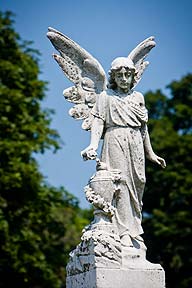
Mt. Hope is not so richly endowed with funerary sculpture and wrought iron as Greenwood Cemetery in Brooklyn or Mt. Auburn in Boston, but there are many noble monuments which are worth a special look. The Ellwanger monument in section V is an enormous seated figure of St. John with an eagle and the inscription, "A Voice From Heaven"; the whole is covered with an elaborate glass case. The Erickson monument, "The Weary Pilgrim," in section G is also worth a special look. Notable angels can also be seen in the east part of section D: the Vicinus monument features an angel of hope with one hand raised and an anchor; the Eckhardt monument has a similar angel (but with spread wings) and anchor.

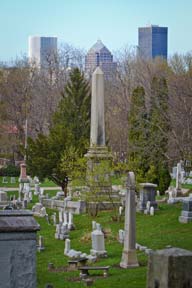
There are also some impressive female figures representing Hope. Draped urns, Celtic crosses, and obelisks abound, the most spectacular of the latter being the Freeman Clarke monument between sections O and P and the Carver memorial in section 2 on Evergreen Avenue. The aficionado of cemetery monuments can also find numerous molded metal markers among the more common stone memorials.

Dedicated Tracts

The growth of Mt. Hope Cemetery cannot be documented solely in the expansion of land areas. Social and religious groups have dedicated specific tracts. Congregation Beth Israel and Congregation Beth El have plots in Ranges 3, 9 and 10. Temple B'rith Kodesh has a plot in Range 7. The University of Rochester has a plot in section O on Fifth Avenue. Others are reserved for Masons, residents of the Rochester Friendly Home, residents of St. John's Home, and members of the Megiddo Mission. Citizen groups representing the Grand Army of the Republic, the Daughters of the American Revolution, and the veterans of World War I have erected special monuments and have contributed greatly to the use of the cemetery for memorial celebrations. Significant expansion has also resulted in the moving of graves from older cemeteries which have been abandoned. The old Buffalo Street burying ground, now the site FIGHT Square, the old cemetery on Monroe and an old cemetery in Brighton have all filled plots on the slopes from old section W.

Mt. Hope Cemetery is a remarkable resource for the student of local history, funerary art, spectacular ancient trees, or the geological grandeur of the Genesee Valley. It is also a delightful, ecologically sound haven for anyone who wants to enjoy the comforts of nature. It will remain a rich and varied asset for the people of Rochester as long as it is used and enjoyed.

mtHopeGazeboGeology

The terrain of Mt. Hope is highly unusual, being the westward extension of the Pinnacle range of mountains which were left as a moraine when the glacier receded. Consequently, the sharp rise and fall of the land, while hardly ideal for farming, proved dramatic and picturesque for development as a parkgarden-cemetery. High in the moraine are a number of kettle formations, sharp and deep, naturally conical holes in the earth. These kettles were formed by large blocks of ice, trapped in the moraine and around which earth piled up. One of the four kettles in Mt. Hope held water and was landscaped as a lake called Sylvan Waters, which still remains in section K. There are two other kettles, both dry, in K and one more in G. Grave plots have been developed in likely spots even on some of these steepest inclines.

The City of Rochester gratefully acknowledges the assistance of the Landmark Society of Western New York in developing the brochure from which this page was created. The text was prepared by Rowland L. Collins of the Department of English at the University of Rochester.

Photographs by Hans Padelt and John A. Wenrich
Engravings by Edward Angevine from "A Guide or Hand-Book for Mount Hope Cemetery" published at Rochester, N.Y. in 1885.

Genealogy

Visit this web site to search our interments.

Tours

The Friends of Mount Hope Cemetery offer guided walking tours of the cemetery each weekend, May through October. Free two-hour, general tours are scheduled on Saturdays at 1 p.m. and on Sundays at 2 and 2:30 p.m.


Loading...

The City of Rochester, NY is an Equal Opportunity Employer. | Terms of Use | Accessibility |  Privacy  | Security |  Contact Us