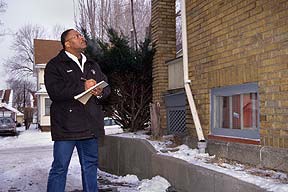
 The City of Rochester has numerous residential, commercial and industrial buildings which are substantially sound and habitable structures which provide housing resources for residents and businesses in the city. The condition and timely maintenance of these existing structures as well as the safe and code compliant construction of newly built buildings play a vital role in the success of our businesses and city neighborhoods. In order to preserve these valuable housing and business resources in the city, to enhance the residential neighborhoods and to protect the safety, health and welfare of the persons who live, work and recreate in the city, the Division of Code Enforcement conducts property and building code inspections and performs necessary code enforcement activity.
There are many aspects of code enforcement; each is uniquely designed to further encourage compliance. The actions taken by a Code Enforcement Officer (CEO) are dependent upon the specific situation and may include but are not limited to the:
- Voiding of a permit;
- Issuance of a Notice and Order;
- Issuance of a stop work order;
- Issuance of an immediate ticket;
- Issuance of a final letter;
- Issuance of housing code tickets;
- The vacating of a unit which poses an immediate hazard to the occupants;
- Executing a work order to remove trash, cut grass or secure a vacant building;
- Scheduling of a Warning meeting in the Law Department;
- Application for Judicial Inspection Warrant;
- Commencement of a proceeding in City Court;
- Commencement of a proceeding in State Supreme Court;
- Pursuit of an order of Demolition
The goal of the City of Rochester's Division of Code Enforcement is to achieve timely voluntary compliance of every Notice and Order issued. Code Enforcement Officers must constantly balance our goal of gaining voluntary compliance with ensuring the health and safety of our residents while attempting to minimize the negative impact exterior code violations have on the quality of life of our citizens.
In order to establish consistent and timely application of code enforcement activity in like situations and to set priorities, it is necessary to group our code enforcement efforts into three categories of structures: Vacant, Occupied Rentals and Owner Occupied. Each of these situation types has unique characteristics. For situations involving vacant structures, please see our web-page "Vacant Property Management".
For all situations, other than those that warrant immediate ticketing, the following process would apply:
Step One: Inspection
An inspection is conducted by a Code Enforcement Officer (CEO) on the basis of a complaint, neighborhood survey, a referral, or an application for Certificate of Occupancy. The primary focus of these inspections are on health, safety and blight. If violations are present, a Notice and Order is issued to the Owner requiring abatement within a specified time frame depending on the violations.
Step Two: Re-inspection
The CEO regularly reinspects a property. If work is in progress, an extension may be given in "good faith" that the work will be completed. If progress is not being achieved on a continual basis, the CEO attempts to contact the owner and get a schedule for the completion of the work. A CEO will try to work with an owner to identify resources to resolve the violations whenever possible. If the owner does not comply with the Notice and Order, the CEO may recommend to the Code Enforcement Coordinator that the case be placed in Enforcement.
Step Three: Enforcement
Once approved, a final warning letter is sent via first class mail to the owner of record. The final warning letter informs the property owner of the possible dollar amount of the fine and attaches a violation work schedule. In order to avoid a fine, the owner must comply, progress or submit an acceptable work schedule for the correction of all outstanding violations.
If upon inspection the property owner has not complied, progressed or submitted an acceptable work schedule for correcting all outstanding violations, a ticket is requested by the CEO and approved by the Code Enforcement Coordinator. Initial fines can range from $50 to $150 per violation, with fines doubling and tripling with subsequent tickets. The CEO will continue to monitor the property for progress or additional ticketing. If necessary, additional ticketing can occur as often as permitted by Chapter 13A of the City Code.
The owner of the property can request a hearing for the ticket through Municipal Codes Violation Bureau. Cases are heard by administrative hearing examiners. If the owner does not respond to the ticket by the default date on the ticket, the fine is doubled. If found guilty, the fine stands. Fines should only be waived if the owner proves that the violation(s) did not exist at the time the ticket was issued. If the property owner fails to pay the fine, a judgment is entered in City Court and the case is sent to a third party collection agency. This may impact the owner's credit rating and/or lead to the garnishing of wages. Uncollected fines may be added to the property tax bill in accordance with §6-94 of the City Charter.
Get Tough Violations: A Get Tough violation is defined as high grass and/or weeds of 10 inches or more, or trash/debris that is loose and not contained.
The process for Get Tough violations is as follows:
The assigned inspector inspects the property for either high grass and weeds or trash and debris. Grass and weeds must be a minimum of 10 inches before it can be cited. If the violation exists, a Notice and Order is sent to the property owner, requiring them to abate the violation. The case is re-inspected 10 days later.
If upon re-inspection the violation "has not" been abated, the owner is issued a ticket for $150 per violation. The City then acts to abate the violation.
For high grass and weeds, the property is sent to a private contractor to correct the violation. This is usually done within three (3) days of submitting it to the contractor. For trash and debris, a work order is submitted to the City's Department of Environmental Services to abate the violation. The time this takes to abate is dependent on the availability of the work crews. The property owner is billed for any services provided.